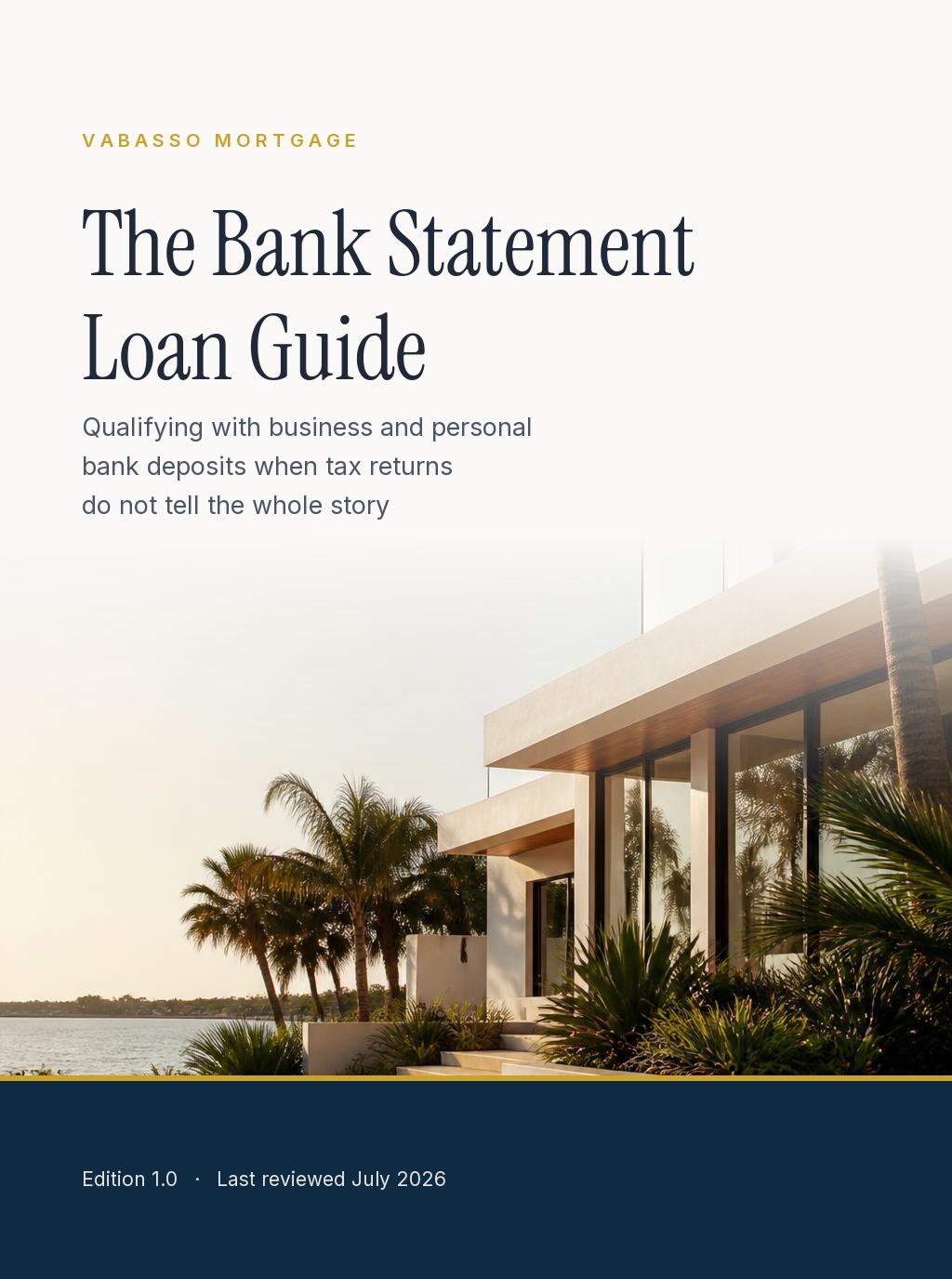
Bank Statement Loan
For self-employed borrowers whose W-2 doesn't tell the whole story.
A non-QM program that qualifies self-employed borrowers using deposits on personal or business bank statements rather than tax returns.
What is a Bank Statement loan?
Bank Statement loans use 12 to 24 months of bank deposits to establish qualifying income, typically applying an expense ratio. Tax returns are not used, making it a strong option for entrepreneurs and business owners whose taxable income understates cash flow.
Designed for
Self-employed borrowers, 1099 contractors, small-business owners, and gig-economy professionals.
Why choose it
Traditional loans review net income after write-offs. Bank statement loans reflect the actual cash you deposit each month.
Common use cases
- ◆Business owners with significant deductions
- ◆Independent contractors and consultants
- ◆Real estate professionals and commission earners
- ◆Physicians and other private-practice owners
Built for borrowers who look like this.
Business owners
Substantial deductions that reduce taxable income.
1099 contractors
Steady deposits without W-2 verification.
Freelancers
Multiple income streams and clients.
Commission earners
Variable but strong deposit history.
The advantages.
No tax returns required
Qualification is based on bank deposits.
Flexible documentation
Personal or business bank statements accepted.
Suited for real self-employed cash flow
Better reflects gross deposits.
Available for many property types
Primary, second home, and investment options.
Things to weigh.
Expense ratios apply
Lenders reduce deposits by an assumed expense percentage.
Pricing premium
Rates run higher than conventional loans.
Longer deposit history
12 or 24 months of consistent deposits often required.
Business ownership verification
CPA letters or business licenses may be requested.
What lenders generally look for.
Requirements vary based on lender guidelines and borrower qualifications. The below is educational — not a commitment or offer of credit.
- Documentation
- 12–24 months of personal or business bank statements
- Business ownership
- Typically verified for 2 years
- Credit expectations
- Varies by lender and loan size
- Occupancy
- Primary, second home, and investment options available
Answers to what borrowers ask most.
Do I need tax returns?
No. Bank statement loans specifically avoid tax return analysis.
How is income calculated?
Lenders average qualifying deposits over 12 or 24 months and apply an expense ratio.
Can I mix personal and business statements?
Some programs allow it, but most focus on one or the other.
Are large deposits scrutinized?
Yes. Non-business deposits are typically excluded.
How long must I have been self-employed?
Generally two years, though exceptions exist.
Can I buy an investment property?
Yes, subject to program guidelines.
Are rates competitive?
They are typically higher than conforming loans but competitive within non-QM.
How much down payment is required?
Varies by credit, occupancy, and loan size.
Can I refinance later?
Yes, into another non-QM or a conventional loan when tax returns support it.
What credit score do I need?
Requirements vary. Higher scores unlock better pricing.
Self-Employed Borrower Guide
How to finance a home using bank statements alone.
Run the numbers.
Educate yourself.
Complementary programs worth exploring.
Asset Qualifier
A streamlined program that qualifies borrowers using verified liquid assets, without requiring income documentation.
Explore Asset Qualifier loan requirementsAsset Depletion
A mortgage program that qualifies borrowers using their liquid assets rather than traditional employment income.
Explore Asset Depletion loan requirementsDSCR
Investor financing that qualifies based on the property's rental income rather than the borrower's personal income.
Explore DSCR loan requirementsNo Ratio
A non-QM program that does not calculate a debt-to-income ratio, focusing instead on credit, assets, and property.
Explore No Ratio loan requirementsAsk about Bank Statement.
Get contextual answers on eligibility, structure, and how this program compares to others. Powered by the Vabasso AI Mortgage Assistant.
Preview · Vabasso AI integration coming soon